The Science Behind Bimini
Oxygen perfusion therapy saturates warm bathwater with ultra-fine oxygen nanobubbles, roughly 2,500 times smaller than a skin pore, so oxygen passes through the skin into soft tissue. In Bimini in-house NIRS testing, muscle oxygen saturation rose from approximately 50% to over 90% in 10-20 minutes.
Rice Sports Medicine Pilot: What It Found
In a Rice University Sports Medicine pilot study (10 participants), reaction-time and coordination scores improved in roughly 46% of post-session tests. Rice Athletics has used the Bimini NanoJet with more than 100 athletes, with no adverse effects reported. This is an internal white paper, not a peer-reviewed trial.
Of post-session reaction-time and coordination tests improved (10-participant pilot)
Muscle oxygen saturation (Bimini in-house NIRS testing)
Athletes have used the NanoJet at Rice Athletics, no adverse effects reported
White paper — not a peer-reviewed trial
What the Research Shows
- Oxygen delivered through skin via ultra-fine nanobubbles (0.005-0.02 microns)
- Reaction-time and coordination scores improved in roughly 46% of post-session tests (10 participants)
- Rice Athletics has used the NanoJet with more than 100 athletes, with no adverse effects reported
- Muscle oxygen saturation rose from ~50% to 90%+ in Bimini in-house NIRS testing
- Safe for daily use with no adverse effects reported
- Internal white paper by Rice Sports Medicine staff — not a peer-reviewed trial
Rice Sports Medicine Pilot
"In a Rice University Sports Medicine pilot study (10 participants), reaction-time and coordination scores improved in roughly 46% of post-session tests. Rice Athletics has used the Bimini NanoJet with more than 100 athletes, with no adverse effects reported. This is an internal white paper, not a peer-reviewed trial."
Authors: Dean Miller, William Paske PhD, Nathan Tran — Rice Sports Medicine. 10 pilot participants; no control group.
How Transdermal Oxygen Delivery Works
The R&D Behind Transdermal Oxygen Delivery
Bimini's founder on the multi-year research process — from early studies in 2019 to medical validation and bringing the first integrated oxygen nanobubble system to market in 2022.
Nanobubble Creation
The NanoJet creates oxygen bubbles just 0.005-0.02 microns in diameter (averaging 0.01 microns), approximately 2,500 times smaller than human skin pores.
Transdermal Delivery
These ultra-fine nanobubbles pass through skin pores via the same mechanism as nicotine patches and topical medications.
Tissue Oxygenation
Oxygen enters soft tissue, where Bimini in-house NIRS testing measured muscle oxygen saturation rising from about 50% to over 90%.
Bimini NanoJet Oxygen Perfusion, Explained in 3 Steps
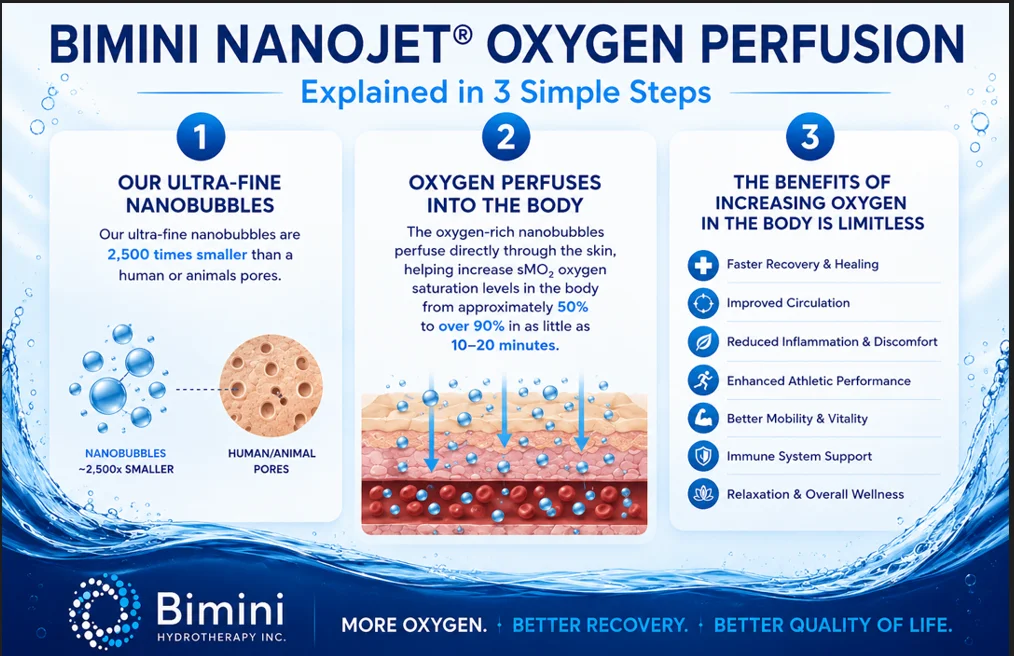
1. Ultra-fine nanobubbles
Bimini nanobubbles measure 0.005 to 0.02 microns, averaging 0.01 microns. That is approximately 2,500 times smaller than a human pore, small enough to pass through the skin rather than sit on it.
2. Oxygen perfuses into the body
The oxygen-rich nanobubbles perfuse directly through the skin, helping raise muscle oxygen saturation (SmO2) from approximately 50% to over 90% in as little as 10-20 minutes in Bimini in-house NIRS testing.
3. What increased oxygen supports
- Faster recovery
- Improved circulation
- Reduced inflammation and discomfort
- Enhanced athletic performance
- Better mobility and vitality
- Relaxation and overall wellness
Rice Sports Medicine Pilot: Key Figures
| Metric | Value | Source |
|---|---|---|
| Reaction-time / coordination improvement | roughly 46% of post-session tests | Rice pilot white paper (10 participants, no control group) |
| Muscle oxygen saturation (SmO2) | approximately 50% → over 90% | Bimini in-house NIRS testing |
| Time to saturation | 10-20 minutes | Bimini in-house NIRS testing |
| Study participants | 10 participants (Rice Sports Medicine pilot) | Rice pilot white paper |
| Nanobubble size | 0.005-0.02 microns (avg 0.01) | Bimini engineering spec |
| Bubble density | 200-300 million per mL | Bimini engineering spec |
| Typical session | 30-60 minutes at 78-100°F | Bimini usage guidance |
| Adverse effects reported | None (100+ athletes at Rice Athletics) | Rice pilot white paper |
"Coaches have used my 'RICE' guideline for decades, but now it appears that both ice and complete rest may delay healing, instead of helping."
Dr. Gabe Mirkin, MD
Creator of the R.I.C.E. protocol, writing in 2015
Read Dr. Mirkin's own article: "Why Ice Delays Recovery" →What we do not claim
Bimini systems are wellness devices, not medical devices. They do not diagnose, treat, cure, or prevent any disease. Individual results vary. The Rice figures above come from a small internal pilot (10 participants, no control group) written up as a white paper by Rice Sports Medicine staff — not a peer-reviewed trial. Consult your physician before beginning any new recovery routine.
Safe and Effective
A study published in the National Library of Medicine states that 100% oxygen can be tolerated for 24-48 hours without any serious tissue damage.
Bimini NanoJet treatments of water saturated at 28 ppm with 95% ultra-fine oxygen nanobubbles consisting of 1 hour or less are a safe treatment with little to no risk.
Adverse Effects Reported
Typical Session Length
Safe Use Frequency
The Science of Transdermal Oxygen Therapy
Published research, the Rice Sports Medicine pilot white paper, and the mechanism behind nanobubble oxygen delivery.
Experience Science-Backed Recovery
Join the thousands of athletes who trust Bimini for their recovery needs.